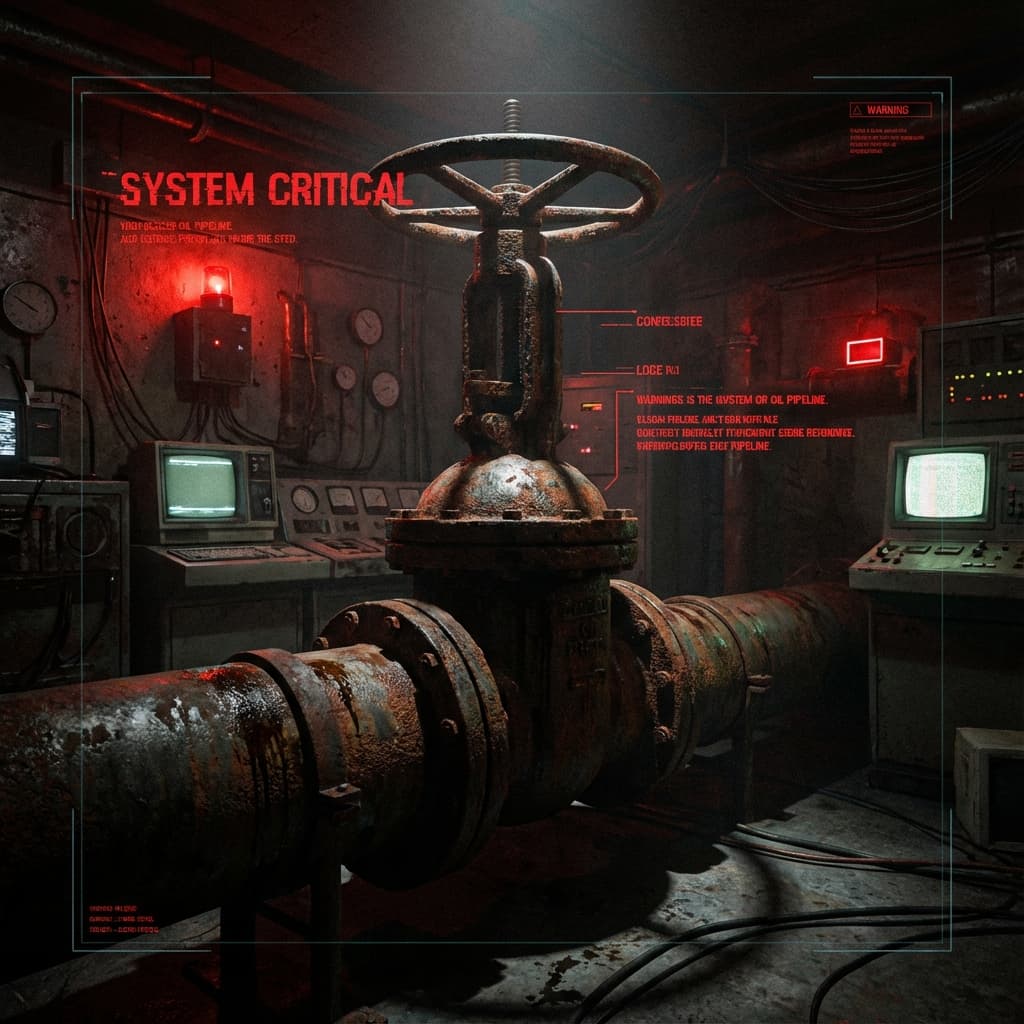
Gas stations ran dry. Prices spiked. The President declared a state of emergency. The Colonial Pipeline ransomware attack of 2021 was the moment cybercrime crossed the line from "business cost" to "national security threat." Here is how one compromised password took down 45% of the East Coast's fuel supply.
Executive Summary
On May 7, 2021, Colonial Pipeline Company, which operates the largest refined products pipeline in the United States, learned it was the victim of a cybersecurity attack. The attackers, a criminal group known as DarkSide, had infiltrated the IT network and deployed ransomware.
Although the Operational Technology (OT) network—the pumps and valves moving the fuel—was not infected, Colonial Pipeline shut it down proactively to prevent the malware from crossing the bridge between IT and OT. This decision, while safety-conscious, halted the flow of 2.5 million barrels of fuel per day.
The Entry Point: A Comedy of Errors
The investigation revealed a terrifyingly simple entry point. The attackers did not use a zero-day exploit. They did not rappel down the elevator shaft.
They used a single VPN account password.
- The account belonged to a legacy employee who was no longer with the company.
- The password had been reused on another site that was previously breached (Credential Stuffing).
- The password was available on the Dark Web in a "dump" of leaked credentials.
- Critically, the account did not have Multi-Factor Authentication (MFA) enabled.
The DarkSide Business Model
DarkSide operates as RaaS (Ransomware-as-a-Service). Think of it like a franchise:
- Developers (The Core Group): Write the malware, maintain the payment site, and handle the negotiations. They take a 20-30% cut.
- Affiliates (The Hackers): Find victims, breach the network, and deploy the ransomware. They take 70-80%.
This model enables specialized labor. You don't need to know how to write crypto-locking code to specific ransomware; you just need to know how to phish an employee.
The Ransom Negotiation
With the pipeline down and pressure mounting from the White House, Colonial Pipeline made the controversial decision to pay. The ransom was set at 75 Bitcoin (approximately $4.4 million USD at the time).
The CEO, Joseph Blount, stated it was "the hardest decision I've made in my 39 years in the energy industry." They paid in hopes of receiving a fast decryptor to restore their billing systems.
The Twist: The Decryptor Failed
DarkSide provided the unlocking tool after payment, but it was incredibly slow and buggy. It was faster for Colonial to restore from their own backups than to wait for the decryptor to finish. This is a common scenario—criminal software quality assurance is notoriously poor.

Technical Deep Dive: The Attack Anatomy
Understanding the specific mechanics of the attack is crucial for engineers. Most advanced threats follow the Cyber Kill Chain model:
RECONNAISSANCE: The attacker gathers information on the target. This can be passive (OSINT) or active (port scanning).
WEAPONIZATION: Creating a deliverable payload (e.g., a malicious PDF or Office macro).
DELIVERY: Transmitting the weapon to the target (e.g., via Phishing or USB).
EXPLOITATION: Triggering the payload to exploit a vulnerability (e.g., CVE-2023-xyz).
INSTALLATION: establishing a backdoor or persistence mechanism (e.g., a scheduled task or registry key).
COMMAND & CONTROL (C2): The compromised system calls home to the attacker server for instructions.
ACTIONS ON OBJECTIVES: The attacker achieves their goal (encryption, extensive data exfiltration, destruction).
The Pivot to Federal Response
This attack changed US policy. The FBI, usually playing a game of whack-a-mole, managed to "hack back." By tracing the Bitcoin ledger, they identified the affiliate's wallet.
Because the affiliate kept their private keys on a cloud server (a major OpSec failure), the FBI obtained a warrant, seized the server, and recovered 63.7 Bitcoin (worth $2.3 million after a price drop). It was a rare victory that showed the "untraceable" nature of crypto is a myth.
Regulatory and Compliance Context
In the aftermath of such incidents, organizations must navigate a complex web of regulatory obligations. Failure to comply can result in severe fines and reputational damage.
GDPR (General Data Protection Regulation)
For organizations operating in or serving citizens of the EU, GDPR mandates strict breach notification timelines (usually within 72 hours). Article 32 requires the implementation of appropriate technical and organizational measures to ensure a level of security appropriate to the risk.
NIST Cybersecurity Framework
The NIST framework provides a standard for critical infrastructure. It is organized around five core functions: Identify, Protect, Detect, Respond, and Recover. This incident highlights failures primarily in the 'Protect' and 'Detect' functions.
Local Legislation (Privacy Act 1988 - Australia)
Under the Notifiable Data Breaches (NDB) scheme, organizations must notify the OAIC and affected individuals if a data breach is likely to result in serious harm. This includes unauthorized access to personal information.
TSA Security Directives
Following the chaos, the TSA (Transportation Security Administration) issued mandatory security directives for pipeline operators. For the first time, these were not suggestions; they were laws.
- Report all cybersecurity incidents to CISA within 12 hours.
- Designate a Cybersecurity Coordinator available 24/7.
- Review current practices against NIST guidelines.
Standard Incident Response Procedures
A robust Incident Response Plan (IRP) is the best defense against chaos. The SANS Institute outlines a six-step process:
- Preparation: Training, tooling, and dry runs (tabletop exercises).
- Identification: Detecting the deviation from normal behavior and determining the scope.
- Containment: Short-term mitigation (isolating the system) and long-term containment (patching).
- Eradication: Removing the root cause (malware, compromised accounts).
- Recovery: Restoring systems to normal operation and monitoring for recurrence.
- Lessons Learned: Post-incident analysis to improve future response.
Lessons Learned
- MFA is Non-Negotiable: If that one VPN account had MFA, the attack would have failed.
- IT/OT Segmentation: The fact that Colonial had to shut down OT because of an IT infection suggests their segmentation wasn't confident. There should be an "air gap" or a completely unidirectional gateway (Data Diode) between business and operations.
- Don't Trust Decryptors: Always plan to restore from backups. Paying the ransom does not guarantee a working recovery tool.
Comprehensive Mitigation Strategies
To prevent recurrence, a defense-in-depth approach is required. This involves layering security controls so that if one fails, another catches the threat.
- Network Segmentation: Isolate critical assets in separate VLANs with strict firewall rules (East-West traffic inspection).
- Endpoint Detection and Response (EDR): Deploy agents that can detect behavioral anomalies, not just file signatures.
- Identity and Access Management (IAM): Enforce Least Privilege and MFA everywhere. Review access logs regularly.
- Regular Audits: Conduct penetration testing and vulnerability scanning (using tools like Nessus or Burp Suite) at least quarterly.
The Colonial Pipeline attack was the "Sputnik moment" for critical infrastructure cyber defense. It proved that in a connected world, a gas pump in Virginia is connected to a server in Russia, and the only thing standing between them is a password.