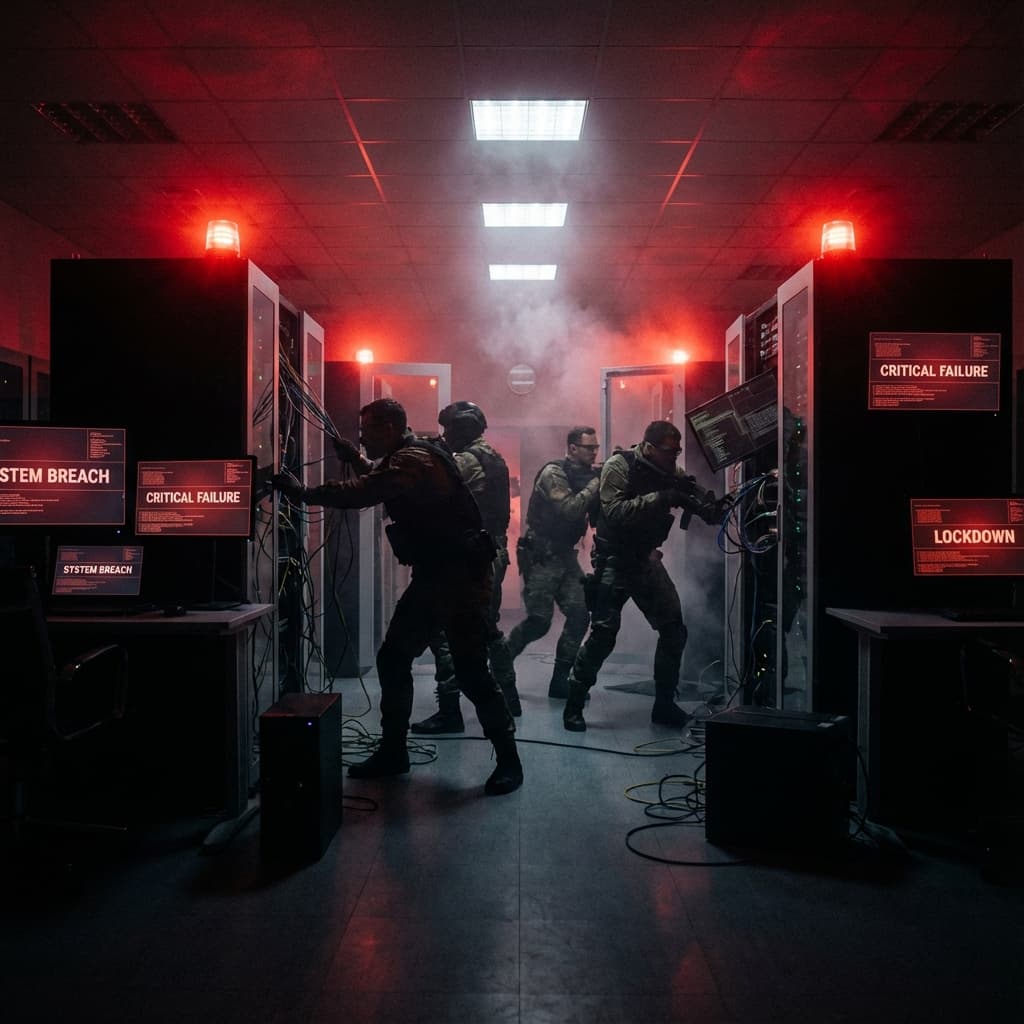
For decades, security was built on the "Castle and Moat" model. We built a big firewall (the moat) and trusted everyone inside the castle. But what if the call is coming from inside the house? Zero Trust is the paradigm shift that assumes the breach has already happened.

Executive Summary
Zero Trust is not a product; it is a strategy. The core mantra is: "Never Trust, Always Verify."
In a traditional network, once you VPN in, you can often access everything—file shares, printers, databases. This allows attackers (like in the Target breach) to move laterally from a compromised HVAC system to the credit card database.
Zero Trust eliminates "implied trust." Every request, whether it comes from the internet or the desk next to you, is treated as hostile until authenticated, authorized, and encrypted.
The Three Pillars of Zero Trust
- Verify Explicitly: Always authenticate and authorize based on all available data points (User Identity, Location, Device Health, Data Sensitivity).
- Use Least Privilege: Limit user access with Just-In-Time and Just-Enough-Access (JIT/JEA).
- Assume Breach: Minimize blast radius and segment access.Verify end-to-end encryption.
Micro-Segmentation
This is the technical enforcement of Zero Trust. Instead of one big network, you break it into tiny zones.
For example, the Web Server can talk to the App Server on port 443. The App Server can talk to the Database on port 3306. But the Web Server CANNOT talk to the Database directly. If the Web Server is hacked, the attacker is trapped there.

Technical Deep Dive: The Attack Anatomy
Understanding the specific mechanics of the attack is crucial for engineers. Most advanced threats follow the Cyber Kill Chain model:
RECONNAISSANCE: The attacker gathers information on the target. This can be passive (OSINT) or active (port scanning).
WEAPONIZATION: Creating a deliverable payload (e.g., a malicious PDF or Office macro).
DELIVERY: Transmitting the weapon to the target (e.g., via Phishing or USB).
EXPLOITATION: Triggering the payload to exploit a vulnerability (e.g., CVE-2023-xyz).
INSTALLATION: establishing a backdoor or persistence mechanism (e.g., a scheduled task or registry key).
COMMAND & CONTROL (C2): The compromised system calls home to the attacker server for instructions.
ACTIONS ON OBJECTIVES: The attacker achieves their goal (encryption, extensive data exfiltration, destruction).
Case Study: Google BeyondCorp
Google invented modern Zero Trust after they were hacked by China in 2009 (Operation Aurora). They realized the perimeter was useless.
With BeyondCorp, Google employees don't use a VPN. They access corporate apps directly over the internet. Access is granted based on the device certificate (Is this a corporate laptop?) and the user context (Is it 2FA authenticated?). If you try to access code from an unmanaged iPad in a coffee shop, access is denied, even if you have the password.
Regulatory and Compliance Context
In the aftermath of such incidents, organizations must navigate a complex web of regulatory obligations. Failure to comply can result in severe fines and reputational damage.
GDPR (General Data Protection Regulation)
For organizations operating in or serving citizens of the EU, GDPR mandates strict breach notification timelines (usually within 72 hours). Article 32 requires the implementation of appropriate technical and organizational measures to ensure a level of security appropriate to the risk.
NIST Cybersecurity Framework
The NIST framework provides a standard for critical infrastructure. It is organized around five core functions: Identify, Protect, Detect, Respond, and Recover. This incident highlights failures primarily in the 'Protect' and 'Detect' functions.
Local Legislation (Privacy Act 1988 - Australia)
Under the Notifiable Data Breaches (NDB) scheme, organizations must notify the OAIC and affected individuals if a data breach is likely to result in serious harm. This includes unauthorized access to personal information.
Implementation Challenges
Zero Trust is hard. It requires knowing exactly what traffic flows are legitimate so you can block the rest.
- Legacy Apps: That mainframe from 1990 doesn't support MFA.
- User Friction: "Why do I have to approve a push notification every time I open a file?"
- Cost: It often requires replacing entire switch fabrics or buying expensive SASE (Secure Access Service Edge) solutions.
Standard Incident Response Procedures
A robust Incident Response Plan (IRP) is the best defense against chaos. The SANS Institute outlines a six-step process:
- Preparation: Training, tooling, and dry runs (tabletop exercises).
- Identification: Detecting the deviation from normal behavior and determining the scope.
- Containment: Short-term mitigation (isolating the system) and long-term containment (patching).
- Eradication: Removing the root cause (malware, compromised accounts).
- Recovery: Restoring systems to normal operation and monitoring for recurrence.
- Lessons Learned: Post-incident analysis to improve future response.
Conclusion
Zero Trust is the direction of travel for the entire industry. The moat has dried up. The walls have crumbled. The only protection left is the identity of the user and the health of the device.
Comprehensive Mitigation Strategies
To prevent recurrence, a defense-in-depth approach is required. This involves layering security controls so that if one fails, another catches the threat.
- Network Segmentation: Isolate critical assets in separate VLANs with strict firewall rules (East-West traffic inspection).
- Endpoint Detection and Response (EDR): Deploy agents that can detect behavioral anomalies, not just file signatures.
- Identity and Access Management (IAM): Enforce Least Privilege and MFA everywhere. Review access logs regularly.
- Regular Audits: Conduct penetration testing and vulnerability scanning (using tools like Nessus or Burp Suite) at least quarterly.